

THE FOALING MARE – Part I
The whole business of getting a foal safely delivered from your mare can be intimidating. When compared to other domesticated large animals (eg cows or sheep), mares are quite different. When a mare foals, it generally happens more quickly and with fewer complications than farm animals. For example, it is extremely uncommon for the foal to be too large to pass through the birth canal of the dam, whereas in many breeds of cattle and sheep this is a common cause of birthing problems, often necessitating caesarean section. However, on the rare occasions when we have problems at foaling, we need to recognise this and act quickly. Like many things with horse health, we do not have the luxury of time to ponder.
In this first article, however, let’s look at the events around a normal foaling with no complications, (the vast majority)
Stages of Foaling
The length of gestation of the mare is usually between 335 and 342 days although a wide variation is possible. Gestation lengths of up to 1 year are not that uncommon. Anything before 320 days is considered premature. Foals born in late winter/early spring often carry a bit longer than those with a due date later in the year. Unlike the situation in cattle (or humans for that matter), we try to avoid inducing mares to foal with drugs, as this usually ends up in a poor outcome for mare and foal. Unless it is medically advised for reasons such as the mare is gravely unwell or the foal is showing signs of distress, and in a setting such as a hospital with experts on hand to manage both mare and foal, we would usually take the approach that the foal will come when it is good and ready.
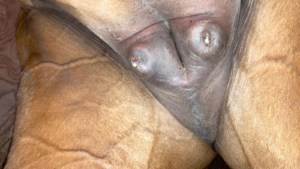 In the 2 -4 weeks before foaling the mare’s udder should slowly fill up with milk. The teats become engorged in the last week, and at this time the mare’s pelvic ligaments often relax, giving the tailhead a raised appearance. The last clue is often the appearance of waxy crusts on the ends of the teats in the day or two before the birth (“waxing”). This is the thick colostrum oozing out of the end of the teat and signifies that birth is imminent.
Unfortunately, mares often decline to read any of these articles and there may be no real clue given by her as to when she will foal. Mares have greater control over when they will give birth than other animals and can hold off until they are being left in peace, usually in the middle of the night. (85% of foalings occur at night).
My first boss in equine Vet Practice told me that one evening he was hosting a meeting of all the local equine vets at his house, and as these experienced vets arrived, he asked them to look over the half-door of a stable, in which his favourite broodmare was standing. The mare was past her due date, and he enquired from all these experts – did she look close to foaling? All these vets said that there were no visible signs, and that the mare was obviously still several days away from the birth. They retreated to his house, had their meeting (with some whiskeys and gossip) and came out a few hours later to go home. Walking past the stable they looked in to find the mare eating hay with a dry colt foal at foot, suckling away and wondering what all the fuss was about.
Birth of A Foal
We split the foaling period into three stages.
Stage 1.
The first stage of labour is when the contractions of the uterus begin. These contractions push the foal towards the cervix which dilates to let the foal out into the pelvis. These contractions are painful, and the mare will show signs which are not dissimilar to colic pain. She may get up and down, paw the ground, and urinate frequently. When the muscular waves have pushed the foal so that the first fluid bag containing the foal, (the allantois), passes through the vulva (and maybe ruptures) then the first stage of labour is over. This stage can last from half an hour to several hours.
Stage 2.
This is the actual birth of the foal. Very powerful muscular contractions propel the foal out of the mare. The mare will usually, but not always, lie down for this stage. The second fluid bag, (the amnion) will rupture and the foal’s feet will appear. The usual presentation is front feet first with the head laying between the legs. The mare will usually be able to push the foal out unaided, but if it looks like she is not making good progress then some traction can be applied to the front legs, pulling downwards towards the mare’s hocks. Once born, the foal will lie for a period behind the mare, who will remain recumbent or sit up on her chest. Do not disturb the foal other than to intervene if membranes from the amnion are occluding the nostrils or the foal appears otherwise in distress. This rest period allows the blood from the placenta to run through the cord into the foal before it is broken by the mare standing up. The whole second stage of birth should last no longer than 30 mins, usually less.
Stage 3.
This is the expulsion of the placenta, the mare ‘cleans’ or ‘cleanses’. This is of particular importance in the mare compared to other species, due to the problems caused by incomplete passing of the placenta. Once the foal is born, tie the hanging placenta into a knot so gravity can help it fall away. The placenta should be passed normally within 1 hour of birth. Once it has fallen away, keep it for the vet to check that it is complete.
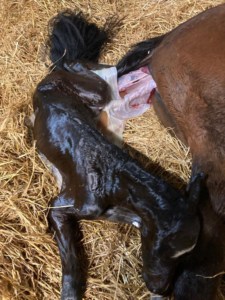
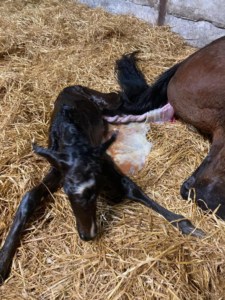

Now the foal is on the ground, we want to leave the pair to bond with minimal disturbance, although we will always keep a check on a first-time mare for signs of anxiety or aggression around the foal.
In the next article, we will look at some of the complications which may arise during the birth process.
Written by John Henderson MRCVS
ARKequine have a large range of supplies available to the breeder to help ensure a stress free foaling. One such product is Lubreze.
Lubreze is an odourless, colourless, non-irritant, ready to use gel characterised by its high lubricant power, helping breeders to assess the presentation of the foal.

For further information on ARKequine’s breeding products click here


