
The Foaling Mare Part II
As we saw in the last article, the mare is fortunate among the domesticated animal species by having a very high percentage of normal, trouble-free births. Of course, this does not mean that complications never occur, and in true equine fashion, when they do, they tend to do so in style.
In this article, we will look at common problems and complications that may arise during or after foaling.
Dystocia in Mares: Every Second Counts
Once the mare’s waters break, signaling the start of the second stage of labour, we should have the foal on the ground within 30 minutes. If the birth of the foal is delayed, every minute that passes reduces their potential for survival. The term ‘dystocia’ is used by vets to describe the situation where something about the way the foal is positioned inside the mare prevents it from getting through the pelvis to the outside world.
In one study of difficult foaling cases in a top equine hospital, the reasons for dystocia were as follows.
- 50% of cases were due to malpresentation of the foal. This means that the foal had not adopted the correct ‘legs out in front of the head’ position. These malpresentations range from the foal having one front leg folded back, to a complete backwards presentation where the foal is ‘reversing’ out of the mare.
- 17% of cases were due to the foal’s front legs being contracted, ie the foal was not able to stretch his legs out in front due to tightness in the tendons. This happens more commonly in larger foals
- 8% of cases were due to more severe deformities of the foal.
- 6% of cases were due to the foal being too large.
- 19% of cases were due to some problem or abnormality with the mare.
Correction of Dystocia
To reposition the foal so that it can be delivered safely ranges from simple to impossible. The mare will often be pushing very hard and the power she exerts makes it extremely difficult to move the foal around, e.g to get a front leg pulled up into the pelvis so the foal can slip out. It is often beneficial to sedate the mare and perform an epidural to reduce her muscular efforts. In more complex malpresentations the chances of having a live foal will be maximised by taking her to a veterinary hospital where she will be given a general anaesthetic and her back end lifted into the air so that the foal slips back into the mare’s belly where it can be manipulated into the correct position and delivered. Unfortunately, quite a few of these extremely complicated dystocias can be the result of the foal being dead inside the womb even before the foaling started. The correct positioning of the foal for delivery is largely down to the foal’s movements in stage 1 labour. If the foal is dead, this positioning does not occur, and the foal is just propelled into the birth canal in a random presentation which can be very hard to correct.
Caesarean Section
Necessary for the most severe dystocia cases, caesarean section is extremely major surgery in the equine, unlike in other domestic species like cattle or sheep where the procedure can be reasonably straightforward. The mare is positioned on her back under full GA and the foal removed through an abdominal incision. As this procedure will be performed on severe dystocia cases where it has been impossible to deliver the foal quickly, the survival of the foal can be in doubt. In one study of caesarean sections in mares, only 19% of foals were born alive. While this figure is disappointing, the major reason for a caesarean operation is to save the mare as a breeding animal (or pet/companion) and the procedure succeeds in saving the life of 80% of the mares which undergo it.
Red Bag Delivery
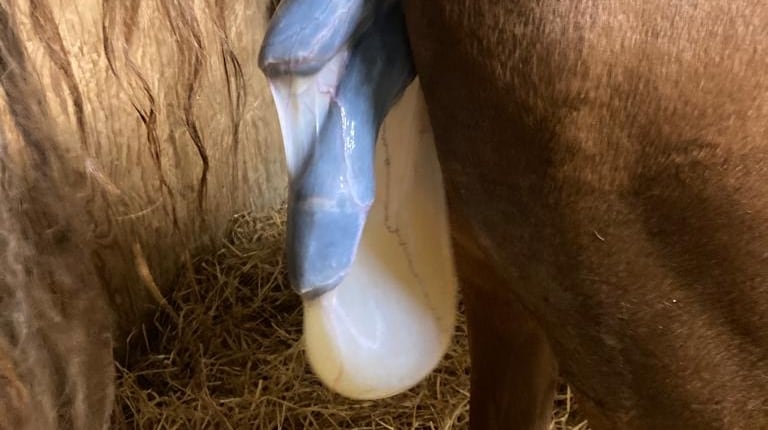
This is a very descriptive term for a foaling where the ‘water bag’ does not burst to let the foal come out normally. Instead, the whole placenta detaches from the womb and appears at the vulva. The placental surface has a red colour and a velvety texture. The foal is trapped inside this ‘red bag’ and will become starved of oxygen very quickly as the placenta has separated from the lining of the womb and will not now be carrying oxygen into the foal via the umbilical cord. This is a true emergency and once the red bag is seen at the vulval lips, it must be cut open and the foal delivered immediately.
Retained Placenta
Once the foal has been delivered, (stage 2 of labour), the placenta should be expelled within an hour (stage 3). If this fails to happen, a series of severe inflammatory changes can occur within the womb which leads to a severe metritis (womb infection), sepsis and toxin production. The absorption of these toxins into the bloodstream of the mare leads to sickness, fever, inappetence, and because of the effect of the inflammatory molecules on the sensitive parts of the hoof, severe laminitis. These events can occur even if only a small part of the placenta has broken off and been retained inside the womb. Therefore, it is important to keep the placenta intact for inspection after the mare has cleaned, to check that it has all come away.
If a placenta is retained for more than about 3-5 hours, veterinary attention should be sought. The vet may attempt to gently remove the placenta manually, often with the help of intravenous oxytocin to ‘squeeze’ the placenta free from the womb. Antibiotic and anti-inflammatory drugs will be prescribed to lessen the chances of life-threatening sepsis.
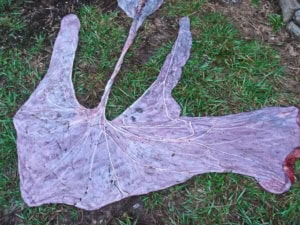 A complete placenta on the grass after a normal foaling. The large section on the right contained the foal, the smaller ‘horn’ on the left lined the ‘empty’ side of the womb. Examining the placenta like this confirms complete expulsion during stage 3 labour.
Complications around foaling are rare but can be very challenging for an owner to deal with. Good preparation for foaling (including a knowledge of what a normal delivery should look like, and how long it should take), is essential. Having an experienced vet on standby will also be vital, as sedation or anaesthesia of the mare, alongside some experience of difficult foalings may prove crucial.
Written by John Henderson MRCVS

Colostrum Refractometer
After foaling, it is vital to ensure your foal has the best start possible. High quality colostrum will give the foal the best chance at having a healthy immune system. A Colostrum Refractometer will test the quality of a mare’s colostrum from just a few drops. This will help the breeder to determine whether additional colostrum is required.
For further information on our range of breeding products visit ark-equine.com


